
15 Best Books for Kids Who Ask “Why?” | Curious Kids Guide
If your child seems to have a question for absolutely everything, you probably know the routine.…
Read More
Some children seem to sit down with their homework and immediately know what to do. Others lose their pencil, forget the assignment, stare at the page for ten minutes, or remember everything they studied until the next morning.
That does not necessarily mean a child is lazy or not trying. Focus, working memory, organization, planning, and self-control are skills that develop over time. Children often need to be shown how to use those skills rather than simply being told to “pay attention” or “study harder.”
The right book can make that process easier. A good resource can turn an abstract problem such as “I can’t concentrate” into something a child can understand and practice. Some books use activities and games. Others teach organization, planning, test preparation, or strategies for managing distractions. A few are written primarily for parents because the most useful support happens outside the pages of the book.
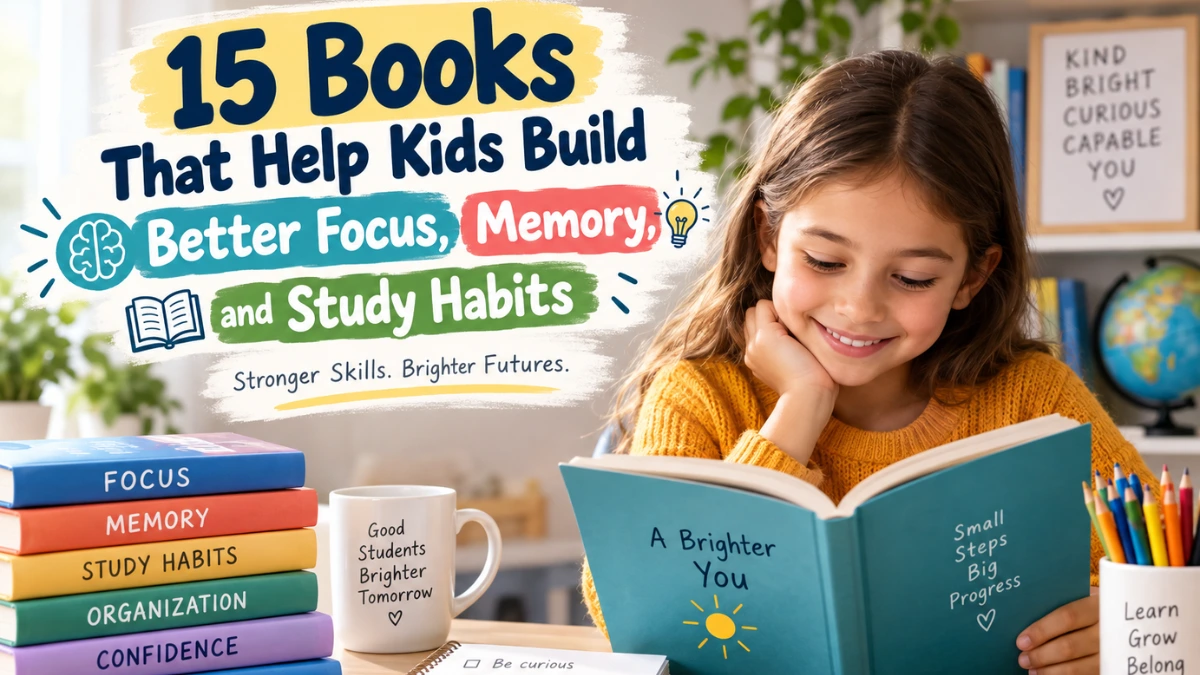
Below are 15 books worth considering for children who want to improve focus, memory, organization, and study habits. The list includes different ages and needs, so the best choice depends on what your child is actually struggling with.
Best for: Ages 6–9 and younger elementary-school students who need practice with memory, self-control, attention, and flexible thinking.
Executive functioning affects many of the everyday skills children use at school: remembering instructions, getting started, staying with a task, switching between activities, and controlling impulses.
Sharon Grand’s Executive Functioning Workbook for Kids approaches these skills through 40 hands-on activities. That makes it a particularly useful option for children who learn better by doing something rather than reading pages of explanations.
The activities are designed for use at home, at school, and in everyday situations. Parents also get guidance about how children learn and how adults can support them.
Why consider it: It combines several skills rather than concentrating only on attention. That makes it useful when a child’s difficulties involve both focus and organization.
Keep in mind: It is aimed at younger children, so older elementary students may want something more advanced.
Best for: Elementary and middle-grade students who need help learning how to study.
Many children are told to study without ever being taught what effective studying actually looks like.
Super Study Skills by Laurie Rozakis focuses directly on that problem. The book covers organization, reading effectively, managing study time, preparing for tests, and handling different types of test questions.
That makes it a practical choice for a child who has started receiving more homework or is moving from simply completing assignments to preparing for quizzes and exams.
Why consider it: It addresses the mechanics of studying instead of simply encouraging children to work harder.
Keep in mind: The book was originally published in 2002, so parents looking for newer perspectives may want to pair it with a more recent resource.
Best for: Students who need a broader introduction to learning and study skills.
Learning to Learn takes a wide approach to academic success. It covers organization, time management, problem solving, reading, test taking, and memory skills through practical activities.
This is particularly useful for parents or educators who want one resource that covers several parts of the learning process rather than focusing exclusively on concentration.
A child who says, “I studied, but I still don’t remember it,” may need more than additional study time. Learning how to organize information, approach a task, and use memory strategies can change how that study time is spent.
Why consider it: It works as a broad study-skills resource rather than a book devoted to one particular difficulty.
Keep in mind: Because it covers a lot of material, younger children may need an adult to guide them through some activities.
Best for: Parents of children ages 4–13 who struggle with organization, attention, planning, time management, or emotional control.
Sometimes the child is not the person who needs to read the book.
Smart but Scattered is written primarily for parents and focuses on executive skills. The second edition addresses children from approximately ages 4 to 13 and provides strategies for understanding a child’s strengths and weaknesses and building specific executive skills.
This can be especially helpful when a child repeatedly forgets homework, loses materials, runs out of time, struggles to begin tasks, or becomes overwhelmed by ordinary routines.
Why consider it: Instead of treating every problem as a motivation issue, it gives parents a framework for understanding the underlying executive skills.
Keep in mind: This is a parent guide, not a workbook that a child would normally work through independently.
Best for: Parents who want to help a child become more organized at school and at home.
A child can understand schoolwork perfectly well and still struggle because of poor organization. Missing assignments, forgotten materials, messy backpacks, and difficulty planning projects can interfere with learning even when the child understands the academic material.
The Organized Child focuses on building organizational systems that can be used in everyday life and school.
It is a useful choice when the main issue is not simply concentration but the larger chain of behaviors surrounding schoolwork: knowing what needs to be done, keeping track of it, organizing materials, and following through.
Why consider it: It looks at organization as a skill that can be taught and practiced.
Keep in mind: Parents should expect to participate. This is more of a family strategy book than a child activity workbook.
Best for: Children ages 8–12 who need direct help with planning, routines, organization, and time management.
This child-focused resource is especially relevant for students who frequently forget what they need to do next.
The book uses examples and activities to help children build habits, create routines, organize belongings, manage time, use reminders, plan projects, and get things done.
Those skills may sound basic, but they are closely connected to successful studying. A child cannot use a good study strategy consistently if they cannot remember when the assignment is due or where their materials are.
Why consider it: The strategies are presented directly to children rather than only to parents.
Keep in mind: It was developed specifically for children with ADHD and related executive-function challenges, although some of the organizational strategies may be useful more broadly.
Best for: Children ages 8–12 with ADHD who need practical academic strategies.
This guide tackles several areas that can make school difficult for children with ADHD, including reading, writing, math, listening, memorization, concentration, note-taking, studying, testing, and procrastination.
One of its strengths is its practical format. Instead of treating school success as one enormous problem, it breaks academic challenges into smaller skills.
That approach can be reassuring for a child who feels overwhelmed. Improving school performance may begin with something as specific as learning how to take better notes or break a large assignment into manageable steps.
Why consider it: It covers both study skills and the everyday difficulties that can interfere with using those skills.
Keep in mind: It is specifically designed around ADHD, so it may not be the best match for a child whose difficulties have a different cause.
Best for: Children with ADHD who struggle with attention, remembering, homework, routines, and staying focused.
The third edition, released in 2026, is a kid-focused workbook covering practical situations at home, at school, and with friends.
Topics include getting homework done, remembering things, staying focused, handling feelings, getting ready in the morning, relaxing, and asking for help.
That combination matters because concentration does not happen in isolation. A child who is tired, overwhelmed, disorganized, or emotionally frustrated may have a harder time getting started and staying with a task.
Why consider it: It connects attention skills with everyday routines rather than treating focus as a single ability.
Keep in mind: It is designed around ADHD, so parents should choose it based on the child’s needs rather than assuming every child with occasional distraction needs an ADHD-focused workbook.
Best for: Children with ADHD who need short, structured activities for self-control, focus, planning, and confidence.
The second edition was published in 2025 and uses activities, games, and illustrations to address skills children can use at school, at home, and with friends.
For a child who finds traditional educational books boring, the workbook format may make practice feel more manageable. The book also addresses self-control and confidence, which can matter when repeated academic struggles have made a child feel discouraged.
Why consider it: It gives children concrete exercises instead of relying entirely on explanations.
Keep in mind: It is a broader ADHD workbook rather than a dedicated study-skills manual, so parents specifically looking for test preparation may want another resource alongside it.
Best for: Children with ADHD who want to understand their condition and learn practical ways to handle school and everyday situations.
The 2026 third edition explains ADHD in language designed for children and includes real-life situations, illustrations, and practical strategies.
Its school-related material makes it relevant to focus and study habits, but it goes beyond academics. It also discusses home life, friendships, feelings, and other situations that children may encounter.
That broader perspective can be valuable because school habits are easier to build when children understand what makes certain situations difficult for them.
Why consider it: It helps children understand their own challenges instead of simply receiving instructions from adults.
Keep in mind: This is an ADHD-specific resource and is not primarily a study-skills workbook.
Best for: Students in grades 6–12 who need help organizing assignments, studying, planning, and managing time.
Older students face a different problem from younger children: they often have multiple teachers, different deadlines, long-term projects, tests, activities, and increasingly independent responsibilities.
The Work-Smart Academic Planner is designed around those demands. It combines planning tools with strategies for organization, time management, study planning, and staying on track.
A planner may sound less exciting than a traditional book, but for some students, the missing ingredient is not more information. It is a reliable system for turning intentions into daily actions.
Why consider it: It gives students something they can actively use throughout the school year.
Keep in mind: A planner only works if the student actually uses it. Parents may need to help establish the routine at first.
Best for: Parents of children ages 4–12 who struggle with executive functioning.
Scattered to Focused focuses on the practical side of executive-function development, including self-control, time management, routines, procrastination, and organization.
One useful feature is its emphasis on understanding a child’s strengths and motivations instead of assuming that every child responds to the same strategy.
This matters because two children can appear to have the same problem while needing very different support. One child may need a visual checklist. Another may need shorter work periods and planned breaks.
Why consider it: It offers strategies that can be applied to everyday routines rather than focusing only on schoolwork.
Keep in mind: It is primarily a parent resource, so it is most useful when an adult is ready to participate in the process.
Best for: Parents, teachers, school professionals, and adults supporting students with significant executive-skill challenges.
This is the more professional choice on the list.
The third edition provides a structured approach to understanding and supporting executive skills such as organization, time management, sustained attention, and emotional control. It also includes practical tools and examples for school settings.
It may be more detailed than what a parent needs for a child with ordinary homework struggles, but it can be valuable when difficulties are persistent or affect multiple areas of school life.
Why consider it: It provides a deeper framework for adults who need to understand executive functioning beyond simple study tips.
Keep in mind: This is not a casual children’s book. It is better suited to adults who want a more comprehensive resource.
Best for: Children around ages 9–14 who enjoy puzzles and want to challenge memory, logic, observation, and problem-solving skills.
Not every useful brain-building book needs to look like a school workbook.
Mensa’s Train Your Brain series uses puzzles and mental challenges to make thinking practice feel like entertainment. The books include different difficulty levels, making them appealing to children who enjoy being challenged.
These books should not be viewed as a replacement for learning how to study. Instead, they can be a fun addition to a child’s reading and learning routine.
Why consider it: Children are more likely to spend time practicing a skill when the activity itself is enjoyable.
Keep in mind: Puzzle books can exercise thinking skills, but they are not a complete system for developing study habits.
Best for: Children who need a short, accessible introduction to practical study strategies.
This newer title focuses on making learning more manageable and introduces strategies such as flashcards, memory techniques, and different ways of practicing information.
It is particularly relevant for parents looking for a child-oriented resource rather than a long academic study guide.
The book can serve as an introduction to the idea that studying is not simply rereading a textbook. Children can experiment with different ways of reviewing information and discover which methods help them remember what they have learned.
Why consider it: It is concise and focused on practical study strategies.
Keep in mind: Its short length means it is better viewed as an introduction than as a comprehensive study-skills reference.
Fifteen options can be useful, but buying several books at once is rarely necessary. Start by identifying the actual problem.
Look first at books such as Learning to Slow Down and Pay Attention, The ADHD Workbook for Kids, or Executive Functioning Workbook for Kids.
Also look at the environment around the child. A quieter workspace, fewer distractions, short work periods, and planned breaks can sometimes make a noticeable difference. Focus is affected by the task, the environment, interest, and the child’s developing executive skills.
Choose a resource that addresses memory and active learning rather than simply encouraging longer study sessions.
Learning to Learn, Executive Functioning Workbook for Kids, and The Homework Squad’s ADHD Guide to School Success are worth considering.
At home, ask your child to explain what they learned without looking at the book. Drawing a diagram, making flashcards, or answering questions from memory can also make studying more active.
Consider The Organized Child, Learning to Plan and Be Organized, or The Work-Smart Academic Planner.
The goal is to build a repeatable system. A simple checklist might include:
The system does not have to be complicated to work.
Several books on this list are specifically designed for children with ADHD, including The Homework Squad’s ADHD Guide to School Success, Learning to Slow Down and Pay Attention, The ADHD Workbook for Kids, and The Survival Guide for Kids with ADHD.
Parents should remember that struggling with attention does not automatically mean a child has ADHD. Occasional distraction is common, and persistent difficulties can have many possible causes. If concentration problems are significantly affecting school or daily life, discussing the pattern with the child’s teacher or an appropriate health professional can be more useful than trying to diagnose the problem at home.
A book can introduce a strategy, but children usually become better at using that strategy through repetition.
For example, reading about organization once will not automatically make a messy backpack organized. A child may need to practice emptying the backpack, sorting papers, checking tomorrow’s schedule, and preparing materials until the routine becomes familiar.
The same is true for concentration. A child who struggles to focus may benefit from shorter work periods followed by brief breaks. Understood recommends starting with manageable periods of focused work and gradually increasing them as the child becomes more comfortable. Breaking large tasks into smaller steps and reducing distractions can also make getting started easier.
Memory works similarly. Children need opportunities to pay attention to information, connect it with what they already know, and retrieve it later. Simply spending more time staring at notes is not necessarily the best way to remember them.
You do not need to turn every evening into a complicated productivity system.
Try this simple routine:
First, choose one skill.
For example, focus, organization, or remembering information.
Next, read a small section of the book.
Avoid trying to complete an entire chapter in one sitting.
Then, practice the strategy immediately.
If the book teaches planning, make tomorrow’s homework plan. If it teaches memory, use the technique on something the child is currently learning.
Keep practice short.
A child is more likely to build a habit from a manageable daily routine than from an occasional marathon study session.
Review what worked.
Ask, “What made studying easier today?” rather than simply asking, “Did you finish?”
That small change can encourage children to notice which strategies actually help them.
There is no single book that will fix every child’s focus or study problems. A six-year-old who needs help remembering instructions has very different needs from a 12-year-old who has six assignments and two tests coming up.
The most useful book is the one that matches the child’s age, challenges, and willingness to participate.
For younger children, activity-based workbooks can make executive-function practice more approachable. For older students, planners and study-skills guides may be more useful. For children with ADHD or significant executive-function difficulties, specialized resources can provide more targeted strategies.
Most importantly, avoid turning these books into another source of pressure. The purpose is not to convince a child that something is wrong with them. It is to give them practical tools they can gradually learn to use.
Helping kids build better focus, memory, and study habits is less about finding a magical book and more about finding the right tools for the particular child.
The 15 books above cover a wide range of needs, from basic executive-function activities for younger children to detailed planning and study resources for older students. Some are written directly for children, while others give parents the strategies they need to create better routines at home.
If you are unsure where to begin, identify the biggest obstacle first. Is your child forgetting assignments, losing focus, struggling to remember information, procrastinating, or simply unsure how to study? Once you know the problem, choosing a useful book becomes much easier.
A good resource should not make studying feel heavier. It should help a child understand how their own learning works and give them practical strategies they can keep using long after the last page is finished.

If your child seems to have a question for absolutely everything, you probably know the routine.…
Read More
How to Help a Child with OCD, A child repeatedly asks, “Are you sure?” A few…
Read More
Artificial intelligence is no longer something children only hear about in science fiction movies. AI is…
Read More
Leave a Reply