Best AI Books for Kids Ages 8 to 12: A Parent’s Guide to Choosing the Right Book
Artificial intelligence is no longer something children only hear about in science fiction movies. AI is…
Read More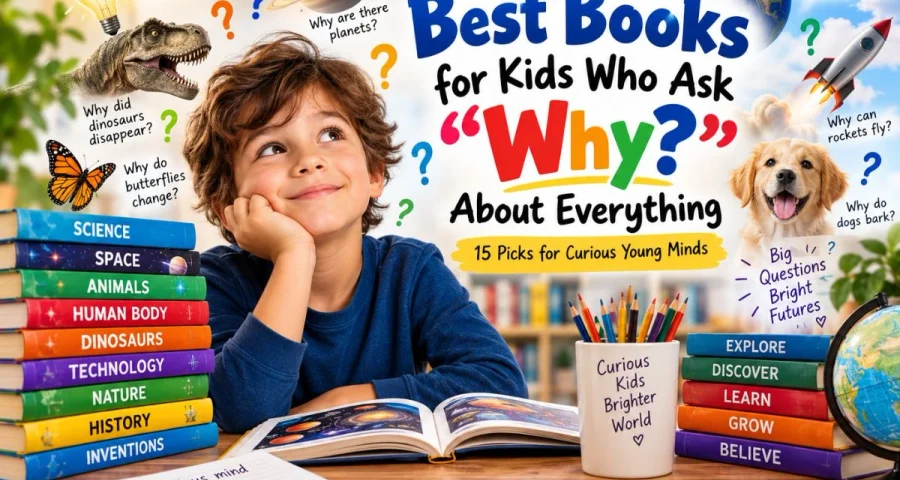
If your child seems to have a question for absolutely everything, you probably know the routine.
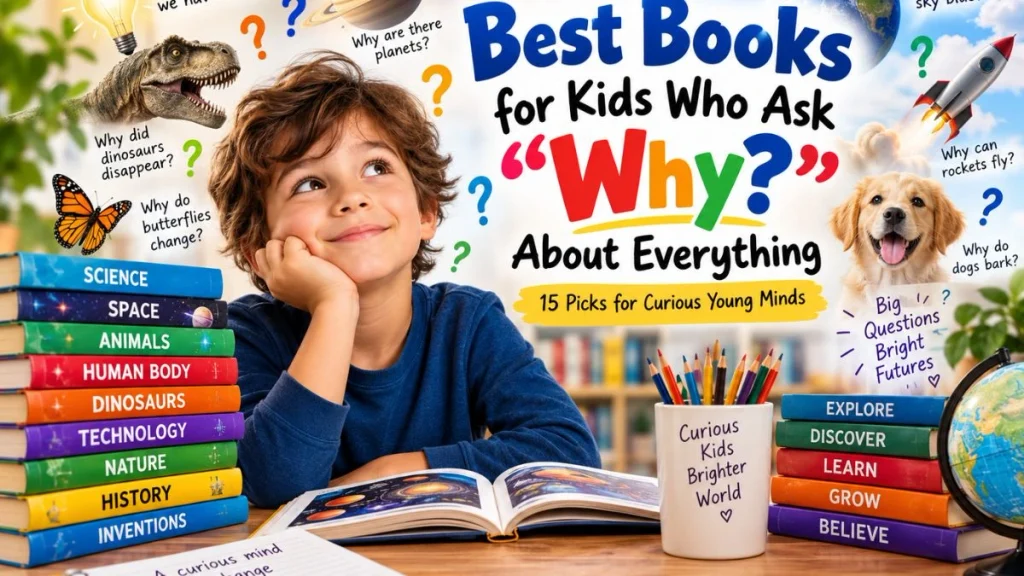
“Why is the sky blue?”
“Why do dogs bark?”
“Why can’t people breathe underwater?”
“Why did the dinosaurs disappear?”
And before you have finished answering, another question arrives.
While answering endless questions can sometimes test a parent’s patience, that curiosity is something worth encouraging. A child who keeps asking why is showing a desire to understand the world rather than simply accepting it as it is.
The right books can turn that curiosity into a powerful learning habit.
Instead of searching the internet every time your child asks a difficult question, you can give them books that encourage exploration, explain complicated ideas in accessible language, and provide plenty of new things to discover.
But choosing the right book isn’t always easy. A five year old and a ten year old may both love dinosaurs, for example, but they need very different kinds of books. Some children love colorful illustrations and short facts. Others want detailed explanations about machines, space, science, animals, or the human body.
That’s why this list isn’t simply a collection of popular children’s books. These 15 picks cover different ages, interests, reading styles, and types of curiosity so you can find something that actually fits your child.
Before choosing a book, think about how your child learns and what they naturally want to know.
A strong book for a curious child should do more than throw facts at them. Ideally, it should encourage them to ask another question.
Look for books that:
Most importantly, don’t assume that the “most advanced” book is automatically the best choice. A book that a child actually wants to open, explore, and return to can be far more valuable than one that is technically more difficult.
With that in mind, here are 15 excellent options to consider.
Best for: Toddlers and preschoolers who are naturally curious
Curious George may not be a science encyclopedia, but he represents something every curious child understands: the urge to find out what happens.
George touches, investigates, experiments, and occasionally gets himself into trouble along the way. That makes the stories useful for starting conversations about curiosity, consequences, problem solving, and safe exploration.
For younger children, curiosity doesn’t always need to begin with complicated facts. Sometimes it begins with a character who makes them want to ask, “What happens next?”
Why consider it: A gentle introduction to curiosity, exploration, and cause and effect.
Best for: Children who enjoy stories as much as facts
What happens when science becomes an adventure?
The Magic School Bus series answers that question by taking children on imaginative journeys into subjects such as the human body, space, weather, plants, and animals.
The strength of the series is its combination of storytelling and science. Instead of simply explaining a concept, the books place children inside an adventure where they can explore it.
That makes them especially appealing to children who find traditional nonfiction books a little too serious.
Why consider it: Great for children who learn naturally through stories, characters, and imaginative exploration.
Best for: Children ages 4–8 who love asking questions
Ada Twist is a wonderful choice for a child who seems to question everything around them.
The story celebrates curiosity while showing that asking questions is only the beginning. Children also need to observe, investigate, experiment, make mistakes, and keep trying.
That message is valuable because curious children sometimes hear that they ask too many questions. A book like this can help them see questioning as something positive.
Why consider it: It encourages children to see curiosity and experimentation as strengths.
Best for: Young children who constantly want quick answers
Some children don’t want to follow a long story before getting to the answer.
They want to know why leaves change color, why the Moon appears to change shape, why certain things happen in nature, and what makes the world work.
This question and answer format makes the book easy to explore in short sessions. Parents can open it when a question comes up, while children can also browse independently.
Why consider it: A useful choice for families that want an accessible reference book for everyday questions.
Best for: Independent readers who love facts
Some children can spend an entire afternoon jumping between completely unrelated questions.
That’s where a large question and answer book can be particularly useful.
With more than 1,111 entries covering subjects including animals, space, the human body, and everyday phenomena, this book gives children plenty of places to begin exploring.
It doesn’t require a child to start on page one and read straight through. They can open it to almost any section and discover something interesting.
Why consider it: Excellent for children who enjoy browsing, trivia, facts, and self directed learning.
Best for: Visual learners and animal lovers
Have you ever told a child that an animal is “huge” only to realize that the word doesn’t really mean much to them?
Actual Size takes a different approach.
The book uses life sized illustrations to help children understand the actual scale of animals and animal parts. Seeing the size of something on a page can make an abstract measurement suddenly feel real.
For children who love animals, this can turn a simple question about size into an opportunity to think about biology, comparison, measurement, and the natural world.
Why consider it: Particularly effective for children who understand ideas better when they can see them.
Best for: Children who become deeply interested in one subject
Some curious children don’t want to know a little about everything.
They want to know everything about one thing.
A child fascinated by volcanoes may want to spend weeks learning about volcanoes. Another might become obsessed with the ocean, dinosaurs, space, or weather.
The I Wonder Why series focuses individual books around specific subjects and uses questions to guide the learning.
Why consider it: A strong choice when your child’s curiosity tends to concentrate intensely on particular subjects.
Best for: Reluctant readers who love humor and unusual facts
Not every child thinks science sounds exciting.
Some hear “science book” and immediately imagine something boring.
Horrible Science takes a very different approach. The series explores scientific subjects through humor, strange facts, illustrations, and topics that children often find fascinating because they are unusual or even a little gross.
That combination can make nonfiction much more approachable for children who aren’t naturally drawn to traditional educational books.
Why consider it: A useful option for children who respond better to humor, jokes, and surprising facts.
Best for: Children who prefer visual and character driven learning
Scientific concepts can sometimes feel abstract to children.
The Basher Science series tackles that problem by presenting scientific ideas through colorful illustrated characters and concise explanations.
Subjects include areas such as atoms, elements, and forces, giving children an opportunity to encounter scientific concepts without being overwhelmed by long blocks of text.
Why consider it: A good option for children who prefer visual explanations and shorter pieces of information.
Best for: Children fascinated by machines and technology
If your child has ever taken something apart because they simply had to know how it worked, this is the kind of book that deserves a place on the bookshelf.
The Way Things Work Now explores the principles behind machines and technology using detailed illustrations and explanations.
It goes beyond simply showing children what a machine looks like. It helps them investigate the mechanisms and scientific principles that make different technologies function.
This is a denser book than some of the others on this list, so it is best suited to children who genuinely enjoy spending time examining how things work.
Why consider it: Excellent for mechanically minded children who want explanations rather than quick facts.
Best for: Children fascinated by Earth, geology, and deep time
How did Earth become the planet we know today?
Questions about the history of our planet can be enormous, but this book approaches the subject in a format designed to make a huge story easier for young readers to follow.
It explores Earth’s history, geological changes, fossils, continents, and other fascinating parts of our planet’s past.
The graphic novel style can also make a subject that might otherwise feel like a textbook much more approachable.
Why consider it: A compelling option for children who ask big questions about Earth and how the world came to look the way it does.
Best for: Dinosaur obsessed kids
There are children who like dinosaurs.
Then there are children who can name dinosaurs before they can properly pronounce half the words adults use every day.
For those kids, a book needs to offer more than a few basic dinosaur names.
This title combines illustrations, doodle style artwork, and bite sized information about dinosaurs and other prehistoric animals. The format makes it easy to browse, revisit favorite subjects, and discover new creatures.
Why consider it: A fun choice for children whose fascination with prehistoric life shows no signs of disappearing.
Best for: Families dealing with the difficult “why” questions
Not every question has a simple answer.
Children eventually start asking questions about dreams, death, relationships, human behavior, and other subjects that can leave even confident parents searching for the right words.
This book brings together questions asked by children and responses from experts in relevant fields.
Its biggest strength is that it doesn’t treat every question as if there is a one sentence answer. Instead, it gives families a starting point for deeper conversations.
Why consider it: Particularly valuable for parents who want help navigating the bigger and more complicated questions children eventually ask.
Best for: Early readers fascinated by the human body
Children don’t have to be older to become fascinated by biology.
The Skeleton Inside You introduces young readers to the bones inside the human body and explains their role in simple, accessible language.
It is part of the Let’s Read and Find Out Science series, which covers a wide range of science subjects for young readers.
Why consider it: A good introduction to human biology for children who are beginning to read science books independently.
Best for: Preschool and kindergarten aged children
For younger children, the best nonfiction book is often one that respects their attention span.
National Geographic Little Kids First Big Book of Why uses photographs, short explanations, and simple questions to explore subjects children encounter every day.
Questions about animals, weather, the human body, sleep, and the world around them can become small learning adventures.
Why consider it: A strong starting point for younger children who are just entering the “why” stage.
With 15 choices available, how do you decide which one to buy?
Start with your child’s current curiosity.
If your child is constantly asking about animals, choose an animal focused book.
If they spend their time looking at the Moon and asking about planets, start with space.
If they are always taking apart toys, investigating household objects, or asking how machines work, choose something focused on technology and mechanics.
If their questions cover absolutely everything, a broad question and answer book may be the better choice.
You should also consider reading ability.
A child can have an advanced intellectual interest while still needing a book written at their actual reading level. Don’t confuse curiosity with reading ability. A child who is fascinated by black holes may still prefer a highly visual book with short explanations.
And don’t underestimate the importance of format.
Some children love encyclopedias. Others prefer stories. Some want illustrations on every page. Others enjoy flipping through hundreds of facts and choosing their own topics.
The best book is often the one that matches how your child naturally enjoys learning.
Buying a good book is only the beginning.
Keep the book somewhere your child can easily reach it. A question that comes up at the kitchen table can become an immediate opportunity to investigate.
And don’t be afraid to say:
“I don’t know. Let’s find out.”
That simple sentence teaches children something important. Adults don’t have every answer, and not knowing something isn’t a reason to stop asking questions.
You can also ask your child what they think before giving them the answer.
If they ask why the sky is blue, for example, ask:
“What do you think is happening?”
Their answer might be completely wrong. That’s okay. The point is to encourage them to make observations, form ideas, and become comfortable investigating.
You don’t need to turn every reading session into a lesson, either.
Sometimes your child can simply sit down and explore.
A few minutes spent discovering a strange animal, an unusual machine, or a fascinating fact can be enough to send them searching for the next question.
A child’s questions are not always about collecting facts.
Sometimes the deeper value is learning how to think.
When children ask questions, compare explanations, investigate information, and discover that some problems are more complicated than they first appeared, they are developing habits that can help them far beyond childhood.
A good nonfiction book can therefore serve two purposes.
It can answer the question your child asked today.
And it can encourage the question they haven’t thought of yet.
That’s what makes curiosity so valuable.
You aren’t simply filling a child’s head with information. You are helping them become comfortable with exploring the unknown.
If your child asks “why?” about everything, don’t rush to make those questions stop.
Protect that curiosity.
Give it somewhere to go.
The 15 books in this guide offer different ways for children to explore science, animals, space, machines, the human body, Earth, dinosaurs, and the many mysteries that surround them.
Some are ideal for preschoolers. Others are better suited to confident elementary readers. Some are perfect for children who love stories, while others are made for kids who would happily spend an afternoon browsing an encyclopedia.
The right choice depends on your child.
Think about what they ask about most. Think about how they like to learn. Then choose a book that makes it easy for them to keep exploring.
Because the child who asks “Why?” today may eventually become the person who asks a much bigger question tomorrow:
“What else can we discover?”
And sometimes, one good book is all it takes to begin that journey.
Disclosure: This article may contain affiliate links. If you purchase through one of these links, I may earn a commission at no additional cost to you.
Artificial intelligence is no longer something children only hear about in science fiction movies. AI is…
Read More
How to Help a Child with OCD, A child repeatedly asks, “Are you sure?” A few…
Read More
Introduction Some children seem to sit down with their homework and immediately know what to do.…
Read More
[…] recommended posts 15 Best Books for Kids Who Ask “Why?” | Curious Kids Guide […]
[…] 15 Best Books for Kids Who Ask “Why?” | Curious Kids Guide […]