
Mistakes Reading Business Books: 10 Fixes That Work
mistakes reading business books Somewhere out there is a business owner with an entire shelf of…
Read More
Ask ten entrepreneurs for a book recommendation and you’ll get ten different lists, each shaped by their own industry, stage, and personal taste. None of those lists were built with your business in mind. They were built around someone else’s path, which makes them a reasonable source of ideas but a poor substitute for a reading list for entrepreneurs actually designed for where you are right now.
Most entrepreneurs default to collecting recommendations passively: a book mentioned in a podcast here, a title spotted on a colleague’s shelf there. Over time this produces a disorganized pile of books with no real connection to each other or to the specific problems the entrepreneur is actually facing.
A personal reading list works differently. It’s built around your goals, your current bottlenecks, and the order in which you’ll actually need each type of knowledge. This guide walks through how to build one, step by step, so your reading time consistently moves your business forward instead of accumulating good intentions on a shelf.
Generic lists are built for broad appeal, which almost always means they mix books meant for very different situations. A list might place a book about validating a first idea right next to a book about leading a hundred-person organization, as if an entrepreneur needs both at the same time.
The result is that readers either try to consume the entire list regardless of relevance, or they pick somewhat randomly, based on which title sounds most appealing rather than which one solves a problem they actually have. Neither approach makes efficient use of limited reading time.
A personal reading list for entrepreneurs solves this by starting from your specific situation rather than someone else’s general recommendations.

Before adding a single book to your list, get honest about what’s actually limiting your business right now. Most entrepreneurs can name their top constraint fairly quickly once they stop and think about it directly, rather than reaching for whatever book crossed their feed most recently.
Ask yourself:
Your answers here should directly shape which books make it onto your list first. A founder struggling to validate an idea needs different books than one struggling to manage a growing team.
Rather than one long, undifferentiated list, organize your reading around a handful of clear categories relevant to running a business. This makes it easier to choose your next book based on your current need, rather than defaulting to whatever is trending.
A useful starting structure includes:
You don’t need every category filled at once. Add books to each section as you identify them, and pull from whichever category matches your current bottleneck.
Related: How to Choose the Right Business Book for Your Stage of Growth
Rather than trying to fill out your entire list immediately, choose a single strong starting book for each category most relevant to your current stage. This keeps the list from becoming another overwhelming pile and instead gives you a clear, manageable starting point.
A reasonable starting set for an early-stage entrepreneur might look like this:
As your business grows and your bottlenecks shift, particularly toward team and leadership challenges, books like Traction by Gino Wickman or The Hard Thing About Hard Things by Ben Horowitz become more relevant additions to the list.
A personal reading list isn’t meant to be read all at once or in a fixed order dictated by someone else. It’s meant to be read in the order your business actually needs it.
If you haven’t validated your idea yet, your validation book comes first, regardless of how appealing a leadership book might sound. If you’re already running a business with a small team and your biggest struggle is operational chaos, an execution or team-focused book takes priority over a book focused on early-stage idea generation.
A simple way to sequence your list is to revisit your bottleneck question from Step 1 every time you finish a book, rather than deciding your entire reading order months in advance. Businesses change quickly, and your reading list should be flexible enough to change with it.
A reading list made up entirely of tactical business books can become narrow over time. Some of the most useful ideas for entrepreneurs come from adjacent categories: psychology, communication, and personal effectiveness.
Books like Never Split the Difference by Chris Voss (negotiation) or Measure What Matters by John Doerr (goal-setting) don’t fit neatly into a single “business strategy” bucket, but they address skills nearly every entrepreneur eventually needs. Leaving space in your list for these adjacent categories tends to produce a more well-rounded foundation than sticking strictly to core business titles.
Related: Common Mistakes People Make When Reading Business Books
A common failure mode is that a “personal” reading list quietly turns into the same kind of overwhelming, undifferentiated pile it was meant to replace just organized into categories instead of one long list.
A few habits help prevent this:
Related: How to Apply Lessons From Business Books to a Small Business
If you want a straightforward way to start, use this basic structure and fill in one book per category based on your current bottleneck:
| Category | Current Book | Why It’s Relevant Right Now |
|---|---|---|
| Idea Validation | ||
| Execution & Operations | ||
| Financial Literacy | ||
| Leadership & Team | ||
| Mindset & Discipline |
Fill in only the categories relevant to your current stage. Leave the rest blank until they become relevant, rather than forcing a book into a category before you actually need it.
1. How many books should be on my personal reading list at once? There’s no fixed number but keeping your active list to five or six books one or two per relevant category tends to be more manageable than a long, undifferentiated list.
2. Should my reading list include fiction or only business books? This guide focuses on business-relevant reading, but there’s no rule against including other genres. The key is being intentional about what each book on your list is meant to help you with.
3. How often should I update my reading list? A quarterly review works well for most entrepreneurs, since bottlenecks and priorities typically shift over months rather than weeks.
4. What if a recommended book doesn’t fit any of my categories? It’s fine to create a new category if a book addresses a genuine, recurring need in your business that isn’t already covered, rather than forcing it into a category where it doesn’t quite belong.
5. Should I finish every book on my list before adding new ones? Not necessarily every single one, but finishing most of what you start is a good general habit. If you consistently abandon books partway through, it’s worth reducing how many you start at once.
6. Is it better to buy several books at once or one at a time? Buying one at a time, based on your current bottleneck, tends to produce more focused reading than buying several in advance based on general interest.
7. How do I decide which category to prioritize first? Go back to your biggest current bottleneck. Whichever category most directly addresses that problem should be your starting point, regardless of what else is on your list.
8. Should I include books I’ve already read on this list? It can help to note books you’ve already read next to each category, both to track what you’ve covered and to identify categories you’ve been neglecting.
9. What if my business doesn’t fit neatly into typical entrepreneur categories? The five categories in this guide are a starting structure, not a strict requirement. Adjust or rename categories to match the actual shape of your business and its specific challenges.
10. Should I get book recommendations from other entrepreneurs, or build this list entirely on my own? Other entrepreneurs’ recommendations are a useful source of ideas, but filter every suggestion through your own current bottlenecks before adding it, rather than adopting someone else’s list wholesale.
A personal reading list isn’t a bigger version of a generic “best books” list. It’s a smaller, more deliberate tool built around your actual bottlenecks, organized by category, and sequenced to match what your business needs right now rather than what’s trending or popular.
Start by naming your biggest current constraint, choose one relevant book for it, and build outward from there as new bottlenecks emerge. A short, well-matched reading list for entrepreneurs that you actually finish and apply will move your business further than a long, impressive-looking one that mostly sits unread.
Suggested External Resources:
MIT Sloan Management Review on building organizational and personal knowledge systems
mistakes reading business books Somewhere out there is a business owner with an entire shelf of…
Read More
If you’ve spent any time researching startup advice, you’ve almost certainly seen both of these titles…
Read More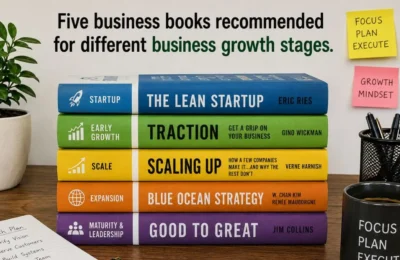
Walk into any bookstore’s business section and you’ll find hundreds of titles promising the same thing:…
Read More
[…] Related Reading List for Entrepreneurs: 5 Steps to Build Your Own […]