Reading List for Entrepreneurs: 5 Steps to Build Your Own
Reading List for Entrepreneurs: 5 Steps to Build Your Own Ask ten entrepreneurs for a book…
Read More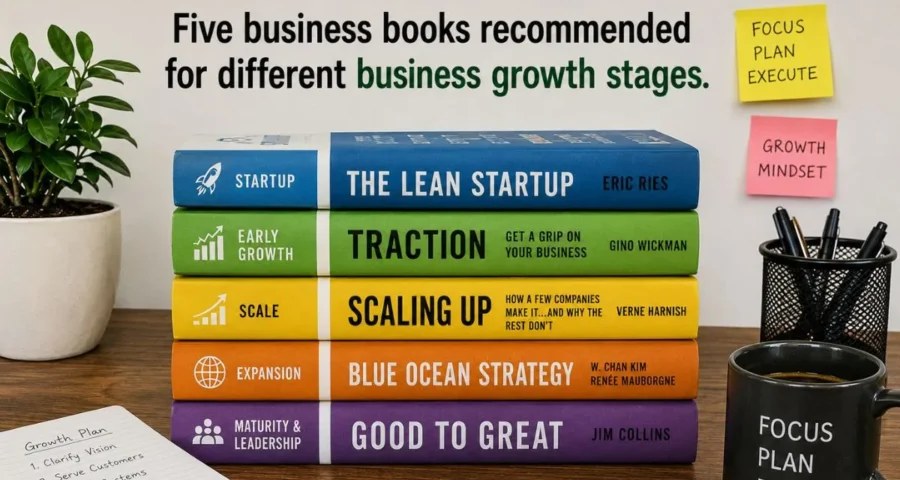
Walk into any bookstore’s business section and you’ll find hundreds of titles promising the same thing: the secret to building a successful company. Some tell you to move fast and break things. Others tell you to slow down, systemize, and protect your margins. A few insist that vision is everything. Others insist vision is worthless without discipline.
Here’s the part nobody tells you upfront: none of these books are wrong. They’re just written for different businesses at different moments in their life. A book aimed at someone validating their first idea will frustrate a founder managing forty employees. A book about scaling operations will feel like noise to someone who hasn’t made their first sale yet.
That mismatch is exactly why choosing business books by growth stage matters more than chasing whatever list is trending this month. It’s rarely that the book was bad it’s that the book didn’t match where you actually were. In this guide, you’ll learn how to identify your real stage of business growth, what kind of guidance genuinely helps at each stage, and which specific, well-regarded books are worth your time right now. By the end, you’ll have a simple framework you can return to every time you’re deciding what to read
Most generic “best business books” roundups are built around popularity, not relevance. They’ll place a book about validating a startup idea right next to one about turning around a struggling public company, as if the two problems have anything in common.
The result? Readers pick up whatever title has the flashiest cover or the loudest recommendation, read it cover to cover, and then wonder why none of it applies to their situation. That’s not a failure of effort. It’s a mismatch of context.
Business growth isn’t a straight line, and it definitely isn’t one continuous problem. It’s a series of distinct phases, each with its own risks, its own bottlenecks, and its own kind of thinking required to get through it. The books that help you most are the ones written for the specific problems of your current phase which is exactly why matching business books by growth stage beats reading whatever’s popular this quarter.
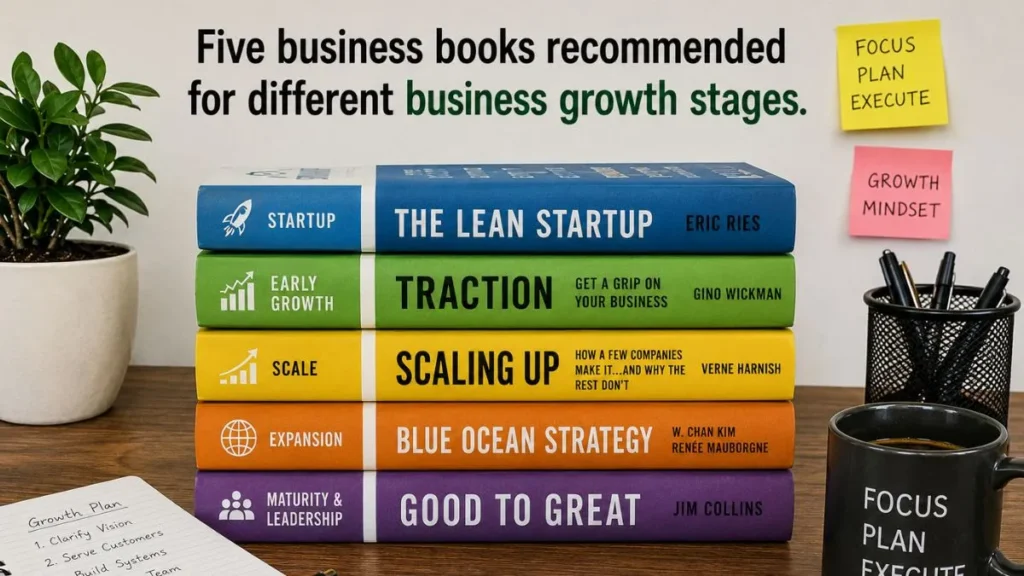
Before recommending a single book, it helps to have a clear picture of where businesses typically sit. Most founders and business owners fall into one of five stages.
1. The Idea Stage. You have a concept, maybe some early research, but no product, no customers, and no revenue yet. Your biggest risk isn’t execution — it’s building something nobody wants.
2. The Startup Stage. You’ve built something and you’re trying to land your first customers. Revenue is inconsistent or nonexistent. You’re testing assumptions in the real world for the first time.
3. Early Growth Stage. You have paying customers and some repeatable process for acquiring them. Your challenge shifts from “does this work” to “how do I do more of what works without falling apart.”
4. Scaling Stage. Revenue is growing steadily, you likely have employees, and the systems that worked when it was just you are starting to crack. Your risk here is operational chaos, not lack of demand.
5. Maturity Stage. The business is established, cash flow is more predictable, and your focus shifts to efficiency, leadership development, competitive positioning, and long-term strategy rather than survival.
Most business owners can place themselves in one of these five stages fairly quickly. If you’re unsure, ask yourself: what’s the single biggest thing keeping me up at night right now? The answer usually points to your stage.
Related: The Beginner’s Guide to Reading Business Books Without Feeling Overwhelmed
At this stage, your job is to test whether your idea deserves to exist before you sink more time and money into it. You don’t need books on hiring or scaling yet. You need books on validation, customer discovery, and thinking clearly about risk.
This book introduced the “build-measure-learn” loop, a simple but powerful way to test business ideas without wasting months building something nobody wants. Ries argues that most startups fail not because they execute poorly, but because they build the wrong thing efficiently. Harvard Business Review has covered similar lean methodology extensively in its work on experimentation-driven strategy, which makes a useful companion read once you’ve absorbed the core framework here.
Thiel’s central argument is that real business success doesn’t come from competing in existing markets, but from creating something new that didn’t exist before going from “zero to one” rather than copying what already works.
Once you’ve moved from concept to execution, your priorities shift toward landing your first customers, building something people will actually pay for, and understanding what makes people say yes or no.
This is a broad, accessible overview of core business concepts — marketing, sales, finance, operations — without the cost or time commitment of business school. It’s especially useful for founders who are strong on product or passion but weaker on fundamentals.
Written by a former FBI hostage negotiator, this book applies high-stakes negotiation tactics to everyday business situations — closing deals, negotiating with vendors, and handling difficult conversations with early customers or partners.
Related: How to Apply Lessons From Business Books to a Small Business
At this point, you’ve proven demand exists. The challenge now is building repeatable systems for acquisition, delivery, and cash flow so growth doesn’t rely entirely on you personally.
Traction introduces the Entrepreneurial Operating System (EOS), a practical framework for running a business with clear vision, accountability, and consistent execution. It’s particularly useful once a founder starts feeling like they’re doing too much themselves.
This book offers a simple cash management system built around the idea that profit shouldn’t be an afterthought it should be allocated first, before expenses are paid. It’s a practical antidote to the common trap of growing revenue while somehow never having cash on hand.
Scaling introduces a different kind of pressure: the systems, culture, and decision-making processes that worked with five people start to break down at twenty-five or fifty. This stage is about building structure without losing what made the business work in the first place. McKinsey’s research on organizational scaling makes a similar point that structure needs to evolve deliberately, not accidentally, as headcount grows.
Horowitz writes candidly about the genuinely difficult decisions that come with scaling a company — layoffs, executive hires that don’t work out, and stretches where the right answer isn’t obvious. It’s less a framework and more an honest account of the pressure that comes with leading a growing organization.
This book explains OKRs (Objectives and Key Results), the goal-setting system used by companies like Google, and how they help larger teams stay aligned around the same priorities without constant oversight from leadership.
Related: Lean Startup vs Zero to One: Which Business Book Fits Your Goals
At this stage, survival isn’t the primary concern — sustained advantage, leadership depth, and long-term positioning are. The right books here focus less on tactics and more on strategy and institutional thinking. Stanford’s business school has published extensively on the leadership patterns that separate durable companies from ones that plateau, which pairs well with both books below.
Collins and his research team studied companies that made a sustained leap from average performance to long-term excellence, identifying common patterns in leadership style, discipline, and strategic focus.
This book argues that the most sustainable growth doesn’t come from beating competitors in an existing market (a “red ocean”), but from creating new, uncontested market space (a “blue ocean”) where competition becomes irrelevant.
It’s common to misjudge your own stage. Founders often feel like they’re “scaling” the moment they hire their first employee, even if revenue is still inconsistent. Others stay stuck thinking of themselves as early-stage long after they’ve built a genuinely repeatable business.
Ask yourself these questions honestly:
Your honest answers to these questions will usually place you more accurately than how “big” or “small” your business feels emotionally — and once you know your stage, choosing the right business books by growth stage becomes far less guesswork and far more targeted.
Related: Common Mistakes People Make When Reading Business Books
A simple, sustainable approach is to read one book per stage-relevant problem, rather than trying to consume everything at once.
This approach keeps your reading focused and directly tied to real problems, rather than becoming a passive habit disconnected from your actual business.
1. How do I know which stage my business is really in? Look at your biggest current problem, not how big your team or revenue feels. If you’re still unsure whether people want what you’re offering, you’re early-stage. If your main issue is managing growth, team, or systems, you’re further along.
2. Can I read books from multiple stages at once? Yes, especially if your business has uneven growth — for example, strong revenue but weak systems. In that case, prioritize the book that addresses your most pressing bottleneck first.
3. Are business books actually useful, or is direct experience more valuable? Both matter. Books won’t replace direct experience, but they can help you avoid predictable mistakes and give you frameworks to interpret what you’re already experiencing.
4. What if a highly recommended book doesn’t apply to my industry? Focus on the underlying principle rather than the specific example. Most frameworks — validation, systems, negotiation, leadership — transfer across industries even when the case studies don’t.
5. Should I read business books cover to cover or just relevant chapters? Reading fully once, especially for shorter books like the ones listed here, helps you understand context. After that, revisiting specific chapters relevant to your current problem is often more useful than rereading the whole book.
6. How often should I revisit my business stage? Every three to six months is reasonable for most growing businesses, since bottlenecks shift faster than most owners expect once real traction begins.
7. Is it better to read broadly or go deep on one framework? Early on, broad exposure — like The Personal MBA — helps you understand fundamentals. As you grow, going deeper into one relevant framework, like EOS in Traction, tends to be more useful than sampling many books shallowly.
8. Do I need an MBA to understand these books? No. Every book recommended here is written for practitioners, not academics, and assumes no formal business education.
9. What if I’m running a very small or solo business — do stages still apply? Yes. Even solo businesses move through idea, early traction, and growth phases, though the “scaling” stage may look different if you never intend to build a large team.
10. Should I take notes while reading business books? Yes. Books read passively rarely change behavior. Writing down two or three specific actions per book, and reviewing them periodically, is what turns reading into real progress.
The right business book isn’t the one with the most five-star reviews or the loudest recommendation online. It’s the one written for the exact problem you’re facing right now, at your current stage of growth.
Instead of collecting an endless list of “must-read” titles, take a more deliberate approach: identify your stage honestly, name your biggest current bottleneck, and choose one of these business books by growth stage that speaks directly to it. Read it with intention, extract a handful of specific actions, and apply them before moving to the next book.
Business growth isn’t linear, and neither is the guidance that helps you through it. Match the book to the moment, and you’ll get far more value from every hour you spend reading.
External links “

Reading List for Entrepreneurs: 5 Steps to Build Your Own Ask ten entrepreneurs for a book…
Read More
Somewhere between your first search for “best business books” and the fifteenth list you scrolled through,…
Read More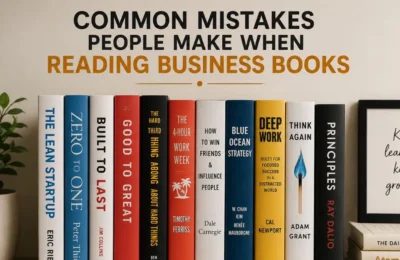
mistakes reading business books Somewhere out there is a business owner with an entire shelf of…
Read More