
Applying Business Book Lessons: 5 Steps That Actually Work
Applying Business Book Lessons: 5 Steps That Actually Work You’ve read the book. Maybe you even…
Read More
Somewhere out there is a business owner with an entire shelf of dog-eared, heavily highlighted books and a business that looks exactly the same as it did a year ago. This isn’t a rare situation. It’s one of the most common outcomes among people who read a lot of business books but never see the results they expected.
The frustrating part is that reading itself isn’t the problem. Most of these readers are genuinely putting in the time and genuinely paying attention while they read. What’s missing is usually a handful of specific mistakes reading business books small habits repeated across dozens of titles that quietly prevent good ideas from ever becoming real change.
This guide walks through the most common mistakes people make when reading business books, why each one happens, and what to do differently. None of these fixes require reading less or reading faster. They require reading a little more deliberately.
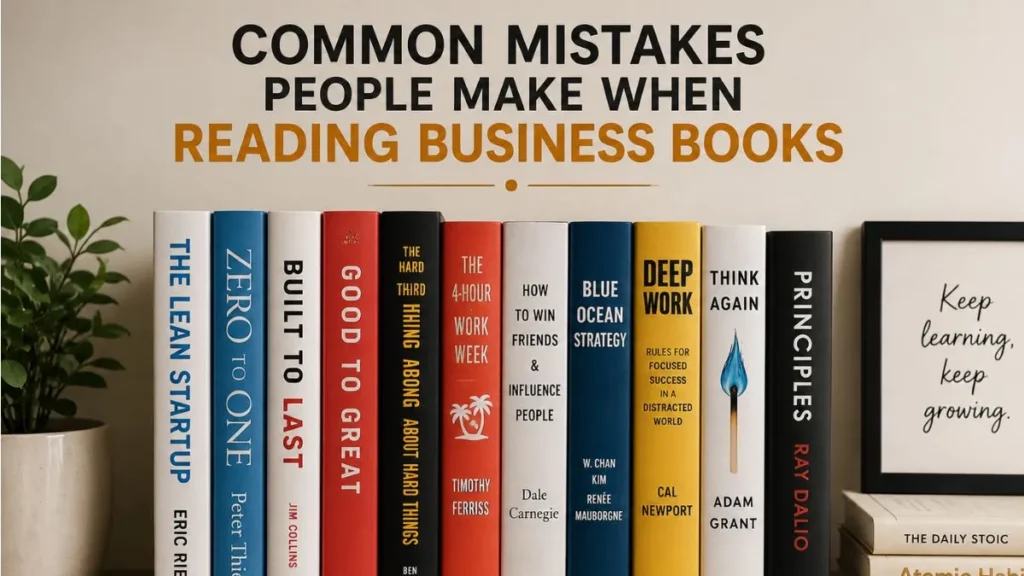
It’s natural to reach for whatever book is trending or most frequently recommended. But popularity measures how broadly appealing or well-marketed a book is, not whether it’s relevant to your specific situation.
A book aimed at scaling a venture-backed tech company can be genuinely excellent and still be almost entirely irrelevant to someone running a small local business that isn’t trying to grow that way. Reading it anyway, simply because “everyone recommends it,” often leads to frustration or a sense that the advice doesn’t apply, when the real issue is a mismatch between the book and the reader’s actual situation.
The fix: Before picking a book, get specific about the exact problem you’re trying to solve or the exact goal you’re working toward. Choose books that speak directly to that, even if they’re less famous than the alternatives.
Novels reward getting lost in the story, moving forward without stopping to question or apply anything. Business books reward the opposite. They’re meant to be interrupted, questioned, and connected back to your own situation as you go.
Readers who carry a fiction-reading habit into business books often finish quickly and retain very little. The information passes through without ever being processed deeply enough to stick or to translate into action.
The fix: Read with a pen or notes app nearby. Pause after each significant idea and ask how it specifically applies to your situation, not just whether it made sense in the abstract.
Highlighting feels productive. It creates a visible record that you engaged with the material. But highlighting a sentence and processing an idea are not the same activity, and only one of them actually helps you remember or apply what you read.
Many readers finish a book with dozens of highlighted passages and, weeks later, can’t recall what most of them were about or why they seemed important at the time. The act of highlighting substitutes for genuine engagement rather than reinforcing it.
The fix: After highlighting a passage, write a single sentence in your own words explaining why it matters to your specific situation. This small extra step is what actually builds retention.
Related: The Beginner’s Guide to Reading Business Books Without Feeling Overwhelmed
Starting several business books simultaneously feels efficient, but it usually means finishing none of them with real depth. Ideas from different books blur together, and the momentum needed to fully absorb any single framework gets diluted across multiple partially-read titles.
The fix: Commit to finishing one business book before starting another, even if it means occasionally setting aside a book that initially seemed exciting. Depth on fewer books consistently outperforms shallow exposure to many.
This is arguably the most consequential item on this list of mistakes reading business books. A reader can genuinely understand and appreciate an idea and still never apply it, simply because the idea was never converted into something concrete enough to act on.
There’s a real difference between “the book talked about tracking cash flow more closely” and “I will spend fifteen minutes every Friday morning updating a simple cash flow spreadsheet.” The first is a summary. The second is something you can actually put on a calendar.
The fix: For every idea worth keeping, write it as a specific action with a clear first step, not as a general takeaway or summary.
A single business book can contain fifteen or twenty potentially useful ideas. Attempting to implement all of them simultaneously after finishing the book is a common and understandable impulse, driven by post-reading motivation. It’s also one of the fastest ways to abandon everything within a few weeks.
The fix: Choose one or two ideas to actually implement, based on which ones address your most pressing current problem, and set the rest aside for later rather than trying to overhaul everything at once.
Related: How to Apply Lessons From Business Books to a Small Business
Case studies in business books usually come from a specific company, industry, and moment in time. Readers sometimes try to copy the exact tactic described, rather than extracting the underlying principle and adapting it to their own situation.
A staffing system built for a company with fifty employees rarely transfers directly to a five-person operation. The principle behind it — clear roles and consistent accountability — usually does transfer, even when the specific implementation needs to look very different.
The fix: When reading a case study, ask what the underlying principle is, separate from the specific company or numbers involved, and think about how that principle would need to change to fit your own scale and resources.
Some ideas from business books, especially ones involving changes to customer experience, team habits, or financial systems, take a few weeks to show a real pattern. Readers sometimes try an idea for a few days, don’t see immediate results, and conclude it doesn’t work.
The fix: Before testing any new idea, decide in advance how long you’ll give it and what specific outcome you’re watching for. This turns a vague impression into something you can actually evaluate fairly.
[IMAGE PLACEHOLDER] Alt Text: Business owner tracking results to avoid common mistakes reading business books Caption: Deciding what “working” looks like before you start makes results easier to judge fairly.
No single business book, regardless of how comprehensive it claims to be, can fully address marketing, finance, leadership, and strategy with equal depth. Readers sometimes feel let down when a book doesn’t cover something they expected, without realizing that focused depth in one area is often more valuable than shallow coverage of everything.
The fix: Approach each book as one piece of a broader, ongoing education rather than a single definitive answer. Depth in one area from one book, paired with depth in another area from a different book, builds a more complete picture over time.
Related: How to Choose the Right Business Book for Your Stage of Growth
Books read once and never revisited fade from memory far faster than most readers expect. Even genuinely useful ideas, absorbed with real attention the first time, often disappear within weeks without some form of review.
The fix: Set aside ten minutes every month or two to skim your notes from books you’ve read recently. This small habit dramatically improves how much of what you’ve read actually stays usable over time.
Before starting your next book, it’s worth pausing to ask a few honest questions about your last one:
If most of your answers point toward passive reading rather than applied reading, it’s worth slowing down before adding another title to the pile.
Related: How to Build a Personal Reading List for Entrepreneurs
1. Is it a mistake to read a business book purely for enjoyment, without trying to apply anything? Not necessarily. It’s reasonable to read some books purely out of curiosity. The mistakes described here apply specifically when a reader expects results or change but isn’t getting them.
2. How many business books should I read per month? There’s no universal number. Reading one book thoroughly and applying something from it is generally more valuable than rushing through several books without retention or action.
3. Is it wrong to highlight books at all? No, highlighting isn’t the problem itself. The mistake is relying on highlighting alone, without adding a brief note in your own words explaining why the passage matters to your situation.
4. What if I genuinely don’t know what action to take from an idea in a book? That’s a sign the idea may need more thought before it’s ready to apply, or that it may not currently be relevant to your specific situation. It’s fine to note it for later rather than forcing an action prematurely.
5. Should I stop reading a book if it feels irrelevant to my business? It’s reasonable to set aside a book that clearly doesn’t match your current situation, rather than pushing through out of obligation. Time is better spent on books more directly relevant to your current problems.
6. How do I know if I’m reading too many books at once? If you can’t clearly recall which idea came from which book, or you haven’t finished any of your current books in the last few weeks, that’s a sign to narrow your focus to one at a time.
7. Is rereading a business book a waste of time if I already read it once? No. Rereading, especially chapters directly relevant to a current problem, often reveals ideas that didn’t feel relevant or fully register the first time.
8. What if I take notes but never look at them again? Notes that are never reviewed provide little benefit over time. A short, periodic review of past notes is what actually reinforces retention and keeps ideas usable.
9. Should I take notes by hand or digitally? Whichever format you’ll actually maintain and review consistently. The format matters far less than whether the notes are specific, action-oriented, and revisited periodically.
10. Can these same mistakes apply to books outside the business category, like mindset or productivity books? Yes. These patterns — passive reading, over-highlighting, trying to apply too much at once — apply broadly across most nonfiction reading, not just business titles specifically.
Most people who read business books without seeing results aren’t reading the wrong books or reading too little. They’re falling into a handful of common, fixable mistakes reading business books: choosing books based on popularity rather than relevance, reading passively, trying to apply too much at once, and never reviewing what they’ve already learned.
None of these fixes require dramatic changes to how much you read. They require reading a little more deliberately, with specific attention to turning ideas into action and giving yourself a real chance to retain what you’ve learned. Small adjustments here consistently separate readers who accumulate a shelf of books from readers whose businesses actually change because of them.
Suggested External Resources:
Harvard Business Review on why knowledge doesn’t automatically translate into behavior change
Featured Image Description: A candid, slightly overhead photograph of a stack of well-worn business books with visible sticky notes and dog-eared pages, next to an open notebook filled with handwritten notes and a cup of coffee gone lukewarm. Warm, natural lighting, conveying genuine, sustained engagement rather than a staged or pristine reading setup.
Applying Business Book Lessons: 5 Steps That Actually Work You’ve read the book. Maybe you even…
Read More
If you’ve spent any time researching startup advice, you’ve almost certainly seen both of these titles…
Read More
Walk into any bookstore’s business section and you’ll find hundreds of titles promising the same thing:…
Read More
Leave a Reply