
Business Books for Beginners: 8 Easy Reads to Start With
Somewhere between your first search for “best business books” and the fifteenth list you scrolled through,…
Read More
You’ve read the book. Maybe you even enjoyed it. You highlighted a dozen passages, nodded along at the case studies, and closed it feeling motivated. Then Monday came, and nothing in your business actually changed.
This is one of the most common and most frustrating experiences for small business owners who read regularly. It’s not that the books are bad or that you weren’t paying attention. It’s that reading and implementing are two completely different skills, and almost nobody teaches the second one.
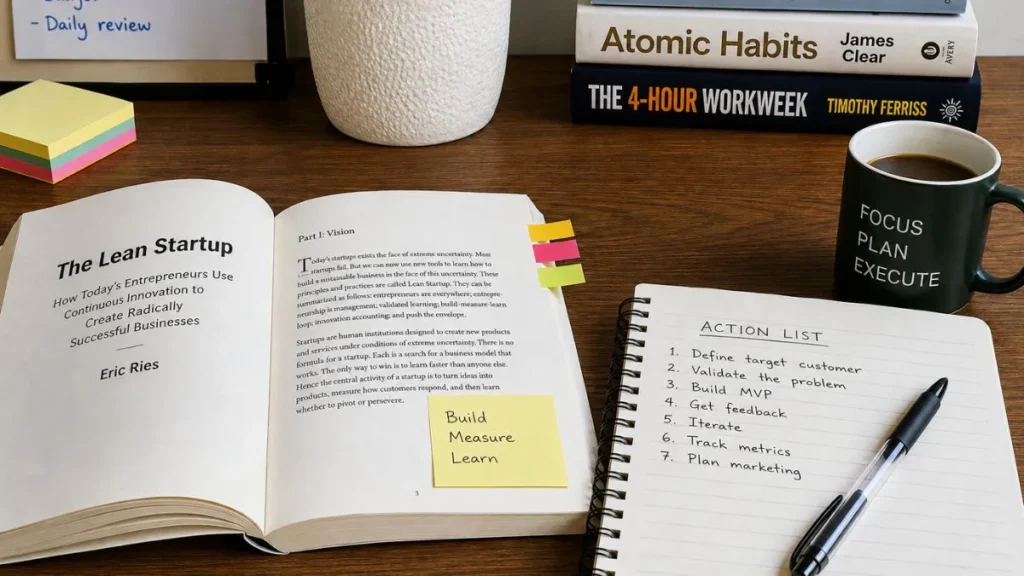
A business book gives you ideas. Your business only improves once those ideas turn into specific decisions, habits, or changes you actually make. That’s the whole challenge behind applying business book lessons: the gap between reading and results isn’t about intelligence or effort. It’s about having a system for translating a chapter into an action.
In this guide, you’ll learn why so many good ideas from books never make it into the business, a simple method for pulling out what’s actually usable, how to test ideas without overhauling everything at once, and how to keep applying lessons consistently instead of just during a burst of motivation right after finishing a book.
Most business owners assume that if an idea makes sense while reading, it’ll naturally show up in how they run things. In practice, that’s rarely true, for a few consistent reasons.
None of this means books aren’t worth reading. It means reading needs to be paired with a simple, repeatable process for pulling out what’s usable and putting it into practice deliberately which is really what applying business book lessons comes down to.
Related: How to Choose the Right Business Book for Your Stage of Growth
Before you can apply a lesson, you need to identify which lessons are actually relevant to your business right now. Not every idea in a book deserves equal attention.
As you read, ask three questions about each idea:
Ideas that pass all three questions are worth flagging for action. Ideas that are interesting but don’t apply to your current situation are worth noting for later, not acting on immediately. This filter alone eliminates most of the overwhelm that comes from finishing a book with pages of highlights and no clear starting point.
This is the step most readers skip, and it’s the one that matters most.
For every idea that passes your filter, write it as a specific action rather than a summary of the concept. There’s a real difference between these two:
| Type | Example |
|---|---|
| Summary | “The book talked about the importance of tracking cash flow weekly instead of monthly.” |
| Action | “Every Friday at 9am, I’ll spend 15 minutes updating a simple cash flow spreadsheet for the store.” |
The summary describes an idea. The action describes something you can actually do on your calendar. If you can’t turn an idea into a sentence like the second one, it’s usually a sign the idea is still too abstract to apply yet, and it needs more thought before it becomes a real change.
A practical example: Mike Michalowicz’s book Profit First introduces the idea of allocating profit before expenses, rather than treating profit as whatever’s left over. For a small business owner, the summary version is “profit should come first.” The action version is: “Open a separate bank account this week and move 5% of every sale into it before paying any other expenses.”
Even after filtering, you’ll likely end up with more good ideas than you can reasonably implement at once. Trying to apply everything simultaneously is one of the fastest ways to abandon all of it within a month.
Instead, choose one idea to test at a time, based on two criteria: it addresses your most pressing current problem, and it’s something you can realistically sustain for at least a month.
For a small grocery or retail business, that might mean testing a new approach to staff scheduling before touching marketing. For a service business, it might mean testing a new client onboarding process before overhauling pricing. The specific idea matters less than picking just one and giving it enough time to actually show results.
Ideas from books often get abandoned not because they don’t work, but because nobody defined what “working” would actually look like or when to check.
For every idea you test, set two things in advance: how long you’ll try it before evaluating, and what specific outcome you’re watching for. A trial period of two to four weeks works well for most small business changes long enough to see a real pattern, short enough that a bad fit doesn’t drag on indefinitely.
For example, if you’re testing a new approach to following up with customers after a purchase, decide in advance: “I’ll do this for three weeks and check whether repeat purchases from that group increased compared to the previous month.” This turns a vague hope into something you can actually evaluate.
Related “How to Set Up a Simple Trial Period for Any New Business Habit”
When an idea from a book doesn’t work exactly as described, the instinct is often to conclude the idea itself was wrong. Frequently, the real issue is that the idea needs to be adapted to your specific business rather than applied exactly as written.
A tactic that works for a business with a large customer base may need to be scaled down for a business with fewer, more personal customer relationships. A system built for a company with several employees may need to be simplified for an owner-operator business.
Before abandoning an idea entirely, ask what specifically didn’t work, and whether a smaller or modified version might still be useful. This is where genuine business judgment comes in. Books provide starting points, not exact instructions guaranteed to work identically in every situation. Harvard Business Review has made a similar point in its writing on adapting management frameworks: the principle usually travels better than the exact tactic.
Gino Wickman’s book Traction introduces the Entrepreneurial Operating System, a framework built around clear priorities, consistent meetings, and accountability. It’s written with growing companies in mind, often ones with multiple departments and dozens of employees.
A small business owner reading this might reasonably feel it doesn’t apply to a five-person operation. But the underlying principles scale down effectively.
Instead of a full quarterly planning system with multiple departments, a small business owner might apply a simplified version: identifying the single most important priority for the next 30 days, writing it somewhere visible, and reviewing progress with staff during a short weekly check-in. This isn’t the full system described in the book, but it captures the core principle clear priorities and consistent follow-up in a form that fits a much smaller operation.
This is the pattern worth repeating with almost any book: extract the underlying principle, then scale the specific tactic to match your actual size and resources.
Related: Book Recommendations for Starting Your First Business
Related: Common Mistakes People Make When Reading Business Books
A sustainable approach doesn’t require a complicated system. A simple three-part habit works well for most small business owners:
This keeps implementation deliberate without turning it into a large project. Over a year, even one applied idea per book adds up to meaningful, compounding change in how the business runs.
Related: How to Build a Personal Reading List for Entrepreneurs
1. Why do I forget most of what I read in business books within a few weeks? This is normal without a deliberate system for capturing action items. Passive reading, even with highlighting, doesn’t reliably translate into retained, applied knowledge.
2. How many ideas from one book should I actually try to apply? One or two at a time is usually more effective than trying to apply everything at once. Depth on a few ideas beats shallow attempts at many.
3. What if an idea from a book just doesn’t fit my type of business? Focus on the underlying principle rather than the exact tactic. Most business concepts can be scaled or adjusted, even if the original example came from a very different kind of company.
4. How long should I test a new idea before deciding if it’s working? Two to four weeks is reasonable for most small business changes long enough to see a real pattern without dragging out a poor fit indefinitely.
5. Should I involve my employees when applying ideas from business books? Where relevant, yes. Ideas involving team processes or customer interaction usually work better with input and buy-in from the people actually doing the work.
6. What if I read a book and none of the ideas feel applicable right now? That’s a reasonable outcome sometimes. Not every book needs to produce immediate action. It’s fine to note ideas for later without forcing implementation before you’re ready.
7. Is it better to apply ideas from one book fully before reading another? Generally yes, at least partially. Finishing the implementation of one solid idea is usually more valuable than accumulating unread ideas from a growing stack of books.
8. How do I know if a change from a book actually worked? Define a specific, measurable outcome before you start testing — whether that’s a number, a habit, or a clear behavior change so you’re not relying on a vague impression later.
9. What if applying an idea creates more work initially? Some worthwhile changes do add short-term friction before they save time or improve results. Weigh this against your trial period outcome rather than abandoning something purely because the first week felt harder.
10. Can these steps work for finance or mindset books, not just business strategy books? Yes. The filtering and action-writing process works across categories, since the core challenge turning an idea into a specific, testable action is the same regardless of the book’s topic.
The value of a business book isn’t determined by how many ideas it contains. It’s determined by how many of those ideas actually change what you do. Reading widely without a system for implementation leads to a shelf full of good intentions and very little real change.
Filter what you read down to what’s genuinely relevant, turn each idea into a specific, testable action, try one thing at a time with a clear check-in point, and adjust rather than abandoning ideas that don’t work exactly as written. This simple discipline — applying business book lessons one at a time, deliberately is what separates business owners who read constantly but stay stuck from those whose businesses genuinely improve.
Suggested External Resources:
Harvard Business Review on adapting management frameworks to different company sizes · · Stanford Graduate School of Business on habit formation and organizational change
Somewhere between your first search for “best business books” and the fifteenth list you scrolled through,…
Read More
Reading List for Entrepreneurs: 5 Steps to Build Your Own Ask ten entrepreneurs for a book…
Read More
mistakes reading business books Somewhere out there is a business owner with an entire shelf of…
Read More