Mistakes Reading Business Books: 10 Fixes That Work
mistakes reading business books Somewhere out there is a business owner with an entire shelf of…
Read More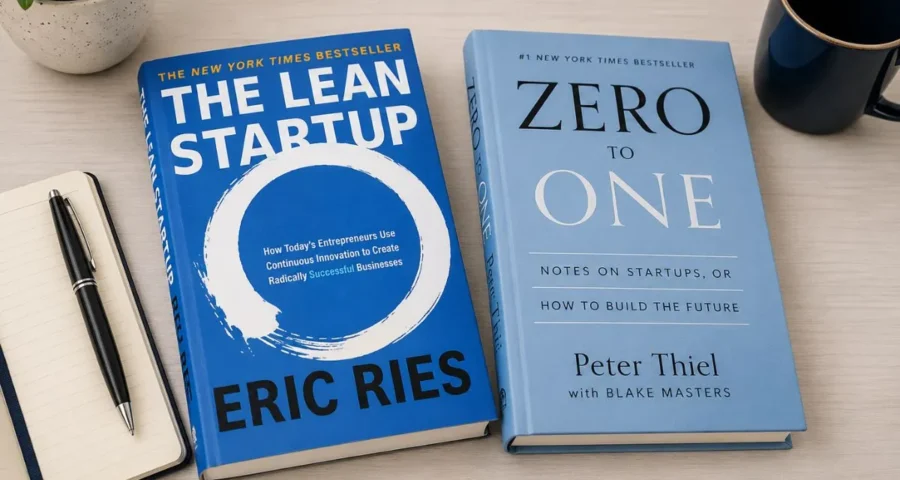
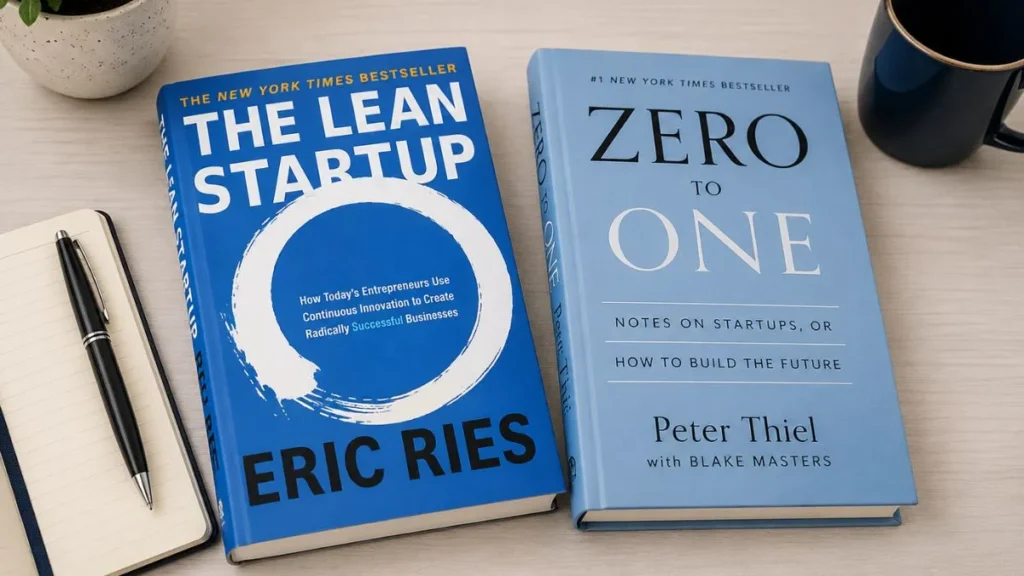
If you’ve spent any time researching startup advice, you’ve almost certainly seen both of these titles recommended often on the same list, sometimes in the very same sentence. That can be confusing rather than helpful. Two books, both considered essential, both written by respected figures in the startup world, and yet they don’t agree on much.
That’s the core of the Lean Startup vs Zero to One debate: they aren’t really answering the same question. One is a method for testing whether an idea works. The other is a philosophy for what kind of idea is worth pursuing in the first place. Reading them as competitors misses the point. Reading them as tools for two different stages of thinking is far more useful.
This guide breaks down what each book actually argues, where they genuinely disagree, who each one is better suited for, and how you can use both without feeling like you have to pick a side.
Author: Eric Ries
Eric Ries built his framework around a simple, uncomfortable observation: most startups fail not because founders execute poorly, but because they spend months or years efficiently building something nobody actually wants. His answer is a disciplined process for learning what customers want before committing significant resources.
The core method is the build-measure-learn loop. Instead of building a complete product based on assumptions, you build the smallest possible version that lets you test a specific assumption, measure how real customers respond, and use that data to decide your next move. This “minimum viable product” isn’t necessarily a smaller version of your final product. It’s whatever is enough to generate honest feedback.
Ries treats a business plan not as a fixed roadmap but as a set of hypotheses to be tested. Success comes from validated learning — confirmed through real customer behavior not from opinions, focus groups, or how convincing the idea sounds in a pitch deck.
Author: Peter Thiel
Peter Thiel’s book starts from a very different place. His core argument is that the biggest business wins don’t come from copying an existing model and executing it slightly better. They come from creating something genuinely new — going from “zero to one” rather than from “one to n” (taking something that already exists and multiplying it).
Thiel is skeptical of competition itself. He argues that businesses succeeding in crowded, competitive markets are often trapped in a cycle of thin margins and constant pressure, while businesses that create something genuinely differentiated can build lasting advantage. He calls this a “monopoly” in the positive sense not illegal market manipulation, but a business so distinct that it faces no direct substitute.
Much of the book focuses on the kind of thinking that leads to original ideas: questioning consensus, looking for important truths that few people agree with you on, and building defensibility into a business from the start rather than trying to out-execute competitors later.
Related: How to Choose the Right Business Book for Your Stage of Growth
The most useful way to understand this Lean Startup vs Zero to One comparison isn’t to rank the books, but to see where their advice actually points in different directions.
| The Lean Startup | Zero to One | |
|---|---|---|
| Core question | Does this idea work? | Is this idea different enough to matter? |
| Approach to risk | Reduce risk through fast, cheap experiments | Accept risk in pursuit of a genuinely original idea |
| View on competition | Focus on learning from the market; competitors are secondary | Avoid competitive markets; build something without direct substitutes |
| Ideal use case | Testing and refining an existing idea | Choosing or shaping which idea to pursue in the first place |
| Risk of misapplication | Over-testing small, incremental ideas that were never going to be big wins | Chasing “original” ideas without validating real demand |
Ries is fundamentally a methodologist. His concern is how you find out whether your idea works, regardless of how ambitious or modest that idea is. Thiel is fundamentally a strategist about the type of idea worth pursuing at all. His concern is less about testing and more about the scale and defensibility of the opportunity itself.
This is why applying only one of these books can lead you astray. Someone who applies Lean Startup principles without ever questioning whether their idea has real differentiation can end up efficiently validating a mediocre, easily copied business. Someone who applies Zero to One thinking without ever testing their assumptions with real customers can end up building an ambitious, “original” idea that nobody actually wants.
Related: The Beginner’s Guide to Reading Business Books Without Feeling Overwhelmed
Rather than choosing one, a more effective approach for most founders is to use them in sequence, matched to where you actually are in your thinking.
Start by using Zero to One‘s questions to pressure-test the idea itself: is this meaningfully different, and why hasn’t someone already done it well? Once you have an idea that survives that scrutiny, move into Lean Startup methodology to test your assumptions cheaply and quickly before committing further resources.
This sequence question the opportunity first, then test the execution uses each book for what it’s genuinely best at, rather than treating either one as a complete standalone system. That’s really the honest answer to the Lean Startup vs Zero to One question: it was never meant to be either/or.
Related: How to Apply Lessons From Business Books to a Small Business
1. Which book should a complete beginner to entrepreneurship read first? Zero to One is often a gentler starting point conceptually, since it’s more about ideas and thinking than a specific operational method. The Lean Startup makes more sense once you have a concrete idea you’re ready to test.
2. Are these books only relevant to tech startups? No. While many examples in both books come from technology companies, the underlying principles testing assumptions and seeking genuine differentiation apply to small businesses, service businesses, and traditional industries as well.
3. Do Eric Ries and Peter Thiel actually disagree with each other publicly? Their books reflect different philosophies and areas of focus, but they’re not framed as direct rebuttals of one another. The tension exists more in how each book gets applied than in outright public disagreement.
4. Can I apply Lean Startup methodology to test a “Zero to One” style idea? Yes, and this is often the most effective combination: use Thiel’s thinking to identify a genuinely differentiated opportunity, then use Ries’s methodology to test and refine it before fully committing.
5. Is Zero to One outdated since it focuses heavily on tech companies from a specific era? The specific examples reflect their time, but the core arguments about differentiation, contrarian thinking, and defensibility remain broadly applicable across industries and eras.
6. Which book is more useful for a small, local business rather than a scalable startup? The Lean Startup‘s testing methodology tends to be more directly practical for small, local businesses, since differentiation at Thiel’s scale building a category-defining company isn’t always the goal for a local service or retail business.
7. Do I need to read these books in full, or can I get the core ideas from summaries? Summaries can give you the core arguments, but both books use extended reasoning and examples that are genuinely useful for internalizing the thinking, not just the conclusions. Full reading is worthwhile if you have the time.
8. Is one of these books considered more “correct” by business experts? Neither is more correct; they address different questions. Business educators and practitioners commonly recommend both, often specifically because they complement rather than replace each other.
9. What if I’ve already started a business without doing either kind of thinking first? Both frameworks are still useful retroactively. You can use Zero to One‘s questions to evaluate whether your business has real differentiation, and Lean Startup methodology to test new features, offers, or directions going forward.
10. Should investors expect founders to have read both books? Many investors are familiar with both, and founders who can speak to genuine differentiation (Zero to One) and evidence of validated demand (The Lean Startup) are often better prepared for investor conversations, even if the books themselves are never mentioned directly.
The Lean Startup and Zero to One aren’t competing answers to the same question. One helps you figure out whether an idea works. The other helps you figure out whether an idea is worth pursuing in the first place. Treating them as rivals means missing what each one actually offers.
If you’re choosing based on where you are right now: use Zero to One when you’re still shaping what to build, and The Lean Startup when you’re ready to test whether people actually want it. That’s the real resolution to the Lean Startup vs Zero to One question used together, in that order, they cover two genuinely different and equally important parts of building something worth building.
Suggested External Resources:
Harvard Business Review’s coverage of lean and experimentation-driven product development
mistakes reading business books Somewhere out there is a business owner with an entire shelf of…
Read More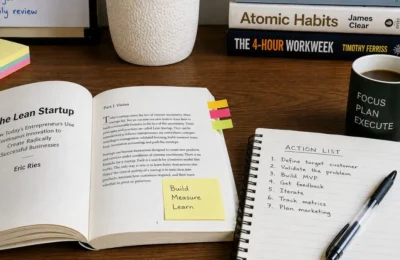
Applying Business Book Lessons: 5 Steps That Actually Work You’ve read the book. Maybe you even…
Read More
Reading List for Entrepreneurs: 5 Steps to Build Your Own Ask ten entrepreneurs for a book…
Read More
Leave a Reply